Why Won't Your Systems Talk?
Many business processes are built around fixed workflows that assume ideal conditions. These designs leave little room for exceptions, edge cases, or changes in context. When deviations occur, the process often breaks down and requires manual intervention to continue.
In addition, many processes depend on interactions with multiple systems and data sources. These systems may be internal or external, modern or legacy, and are rarely designed to work seamlessly together. As a result, users are forced to switch between tools, manually coordinate steps, and fill gaps in automation.
Agents can deal with all these issues and much more… 24×7.
How Agentic Solutions Work
Agentic AI addresses these challenges by enabling adaptive, goal-driven processes rather than rigid step-by-step workflows. AI agents can assess context, select actions dynamically, and adjust execution paths based on available information, business rules, and real-time conditions.
These agents can operate across multiple systems and data sources, invoking APIs, querying databases, interacting with enterprise applications, and incorporating human input when required. Agentic solutions support both predefined flows for well-understood processes and more flexible execution models for situations where outcomes are known but the path is not.
Agentic solutions enable effective collaboration between AI, humans, and systems, unlocking automation scenarios that are difficult or impractical with traditional workflow tools.
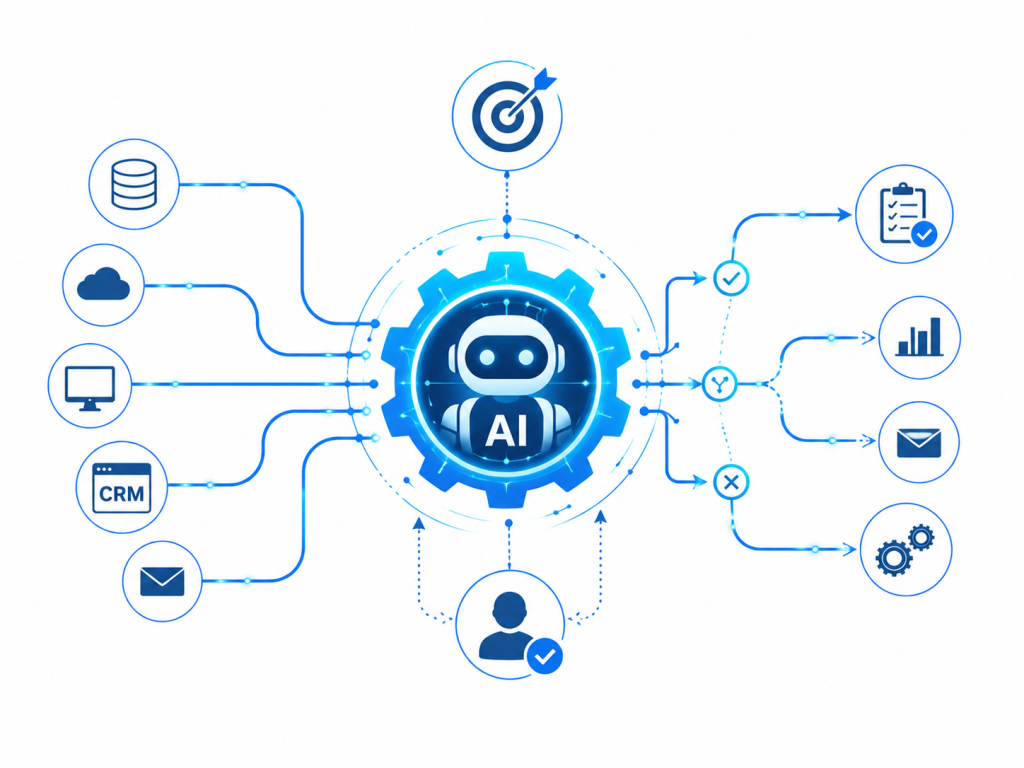
The result is automation that better reflects how work actually happens. Processes become more resilient, easier to extend, and less dependent on manual coordination.